
Article 5 in a 7-part series on Agentic AI for Banking
Introduction
At First Regional Bank, the loan processing department once had a backlog stretching to 26 days. Document verification, credit analysis, compliance checks, and approval routing created a cumbersome process that frustrated both customers and loan officers. Today, that same bank processes routine loans in under 48 hours, has reduced operational costs by 31%, and maintains a compliance accuracy rate of 99.7% — all while handling 42% more applications with the same number of employees.
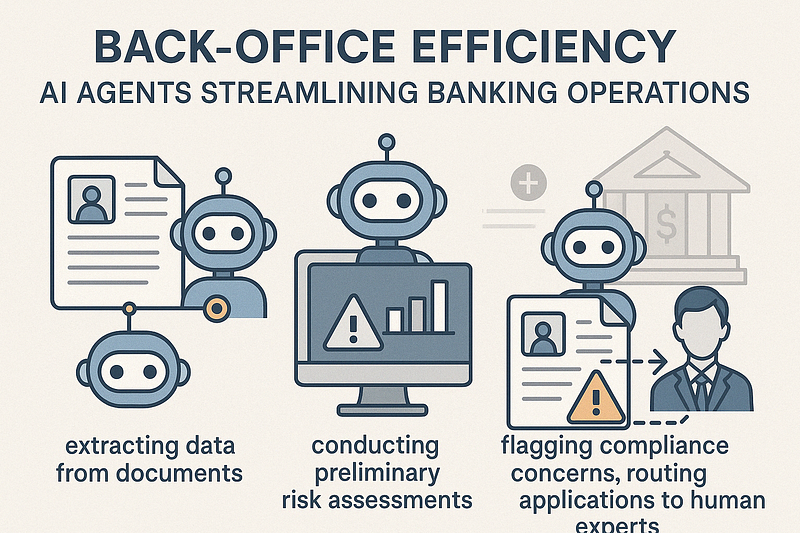
The difference? AI agents working behind the scenes to streamline every aspect of the loan process — from automatically extracting data from documents to conducting preliminary risk assessments, flagging compliance concerns, and routing applications to the right human experts at exactly the right time.
While customer-facing AI applications often receive the most attention, some of the most transformative impacts of AI agents in banking are happening behind the scenes — in the back-office operations that form the foundation of every banking service. In our previous articles, we've explored AI's impact on customer service, security, and personalization. Now, we'll examine how AI agents are revolutionizing the operational engine that powers modern banking.
The Back-Office Challenge in Banking
Back-office operations have long presented significant challenges for banks of all sizes:
- They typically consume 40–60% of a bank's operating budget
- They often involve repetitive, manual processes prone to human error
- They frequently create bottlenecks that impact customer experience
- They must maintain rigorous compliance with ever-changing regulations
Until recently, banks faced difficult choices: accept high operational costs, offshore processes to reduce expenses (often creating quality and control challenges), or invest in rigid automation systems that couldn't adapt to changing needs. AI agents are now providing a fundamentally different solution.
Beyond Basic Automation: What Makes AI Agents Different
Many banks have attempted to streamline operations with traditional automation tools, from basic macros to robotic process automation (RPA). While these tools have value, they typically:
- Follow rigid, predetermined paths
- Struggle with document variations or exceptions
- Require extensive reprogramming when processes change
- Can't make judgment calls when faced with ambiguity
AI agents represent a new generation of operational efficiency tools that overcome these limitations. Let's explore what makes them fundamentally different.
1. Intelligent Document Processing
Banking operations are document-intensive, from loan applications to account opening forms, identity verification documents, and regulatory filings. AI agents transform document handling through:
- Unstructured data extraction: Pulling relevant information from diverse document formats
- Context-aware understanding: Recognizing the meaning of information beyond simple keyword matching
- Discrepancy identification: Flagging inconsistencies across multiple documents
- Continuous learning: Improving accuracy by learning from exceptions and corrections
A mid-sized bank implemented AI document processing and reported reducing document handling time by 78% while improving data accuracy from 92% to 99.3%.
2. Adaptive Process Orchestration
Unlike rigid automation tools, AI agents can orchestrate complex processes that require judgment and adaptation:
- Determining optimal routing based on application characteristics
- Adjusting required documentation based on risk assessment
- Prioritizing workloads dynamically to meet service targets
- Identifying process bottlenecks and suggesting improvements
This adaptability allows processes to evolve continuously rather than requiring periodic redesign.
3. Intelligent Decision Support
Perhaps most significantly, AI agents provide decision support that combines rule-based policies with learned patterns:
- Pre-scoring applications based on comprehensive criteria
- Identifying exceptions that warrant human review
- Providing context-relevant information to human decision-makers
- Explaining the reasoning behind recommendations for transparency
This decision support accelerates straightforward cases while ensuring complex situations receive appropriate human attention.
Real-World Success Stories
Global Bank Transforms Mortgage Operations
A top-ten global bank implemented AI agents across their mortgage operations. The results transformed both efficiency and customer experience:
- Average processing time reduced from 27 days to 6 days
- Document processing costs decreased by 67%
- Exception handling improved from 71% to 94% first-time resolution
- Customer satisfaction scores increased by 42 points
The bank's COO noted: "We didn't just make an inefficient process faster — we fundamentally reimagined how mortgage processing works when powered by intelligent agents."
Regional Bank Revolutionizes Compliance Monitoring
A regional bank with 86 branches implemented AI agents specifically for compliance monitoring and reporting:
- Suspicious activity detection improved by 72%
- False positive alerts decreased by 61%
- Regulatory reporting preparation time reduced by 83%
- Audit findings decreased by 67% in the first year
This implementation demonstrated that AI can simultaneously improve compliance quality while reducing its operational burden.
Five Key Operational Areas Transformed by AI Agents
1. Account Opening and Onboarding
Traditional account opening processes often create a poor first impression through repetitive information requests, lengthy processing times, and frequent follow-ups. AI agents streamline this critical process by:
- Pre-filling applications from existing data and documents
- Conducting real-time identity verification
- Automating know-your-customer (KYC) checks
- Identifying cross-sell opportunities based on application data
One national bank reduced account opening time from 24 hours to under 15 minutes while increasing new account cross-sell rates by 34%.
2. Loan Processing and Underwriting
Loan operations typically involve multiple steps, handoffs, and decision points. AI agents transform this process through:
- Automated document intake and data extraction
- Preliminary credit analysis and scoring
- Identification of missing information or documentation
- Preparation of complete loan packages for final underwriting
A credit union implementing AI-powered loan processing increased loan officer capacity by 230% while reducing decision time by 72%.
3. Regulatory Compliance and Reporting
Compliance obligations continue to expand, creating significant operational burdens. AI agents help manage this complexity by:
- Continuously monitoring transactions for regulatory concerns
- Automating routine regulatory filings
- Tracking regulatory changes and their operational impacts
- Preparing audit-ready documentation and explanations
One regional bank estimated that AI compliance tools saved over 12,000 person-hours annually while improving reporting accuracy.
4. Exception Handling and Problem Resolution
Banking exceptions (unusual transactions, process deviations, etc.) traditionally require disproportionate resources to resolve. AI agents improve exception handling through:
- Automatic categorization of exception types
- Retrieval of relevant information from multiple systems
- Recommendation of resolution approaches based on previous cases
- Tracking trends to identify root causes for process improvement
A banking service provider implementing AI exception handling reduced resolution time by 67% while improving first-time resolution rates by 42%.
5. Data Management and Reconciliation
Financial data integrity is foundational to banking operations. AI agents enhance data quality through:
- Automated reconciliation across multiple systems
- Identification of data anomalies and potential errors
- Correction of routine data issues without human intervention
- Continuous data quality monitoring and improvement
A mid-sized bank reported reducing reconciliation efforts by 78% while improving data accuracy measures across systems.
Implementation Considerations for Banks
Start with Process Analysis
Successful back-office AI implementation begins with understanding current processes:
- Document current workflows, bottlenecks, and pain points
- Quantify both operational costs and customer experience impacts
- Identify high-volume, rules-based processes for initial implementation
- Involve front-line staff in identifying improvement opportunities
This analysis ensures AI addresses the most valuable opportunities first.
Consider Change Management Early
Operational AI changes how people work. Effective implementations address this through:
- Early involvement of affected teams in design and testing
- Clear communication about how roles will evolve rather than disappear
- Investment in reskilling for higher-value activities
- Recognition and reward systems for adoption and improvement
Banks that invest in change management report 62% faster time-to-value from AI implementations.
Build for Integration and Scalability
Rather than implementing isolated AI solutions, successful banks build integrated platforms:
- Ensure AI agents can access data across relevant systems
- Implement consistent governance and control mechanisms
- Design for scalability across multiple operational areas
- Build feedback loops for continuous improvement
This architectural approach maximizes long-term value while minimizing technical debt.
Addressing Common Concerns About Back-Office AI
Will AI Eliminate Banking Jobs?
This is perhaps the most common concern, but experience shows a more nuanced reality:
- Routine data processing roles do typically decline
- New roles emerge in AI oversight, exception handling, and process design
- Customer-facing roles often expand as staff are freed from administrative tasks
- Overall employment often remains stable but shifts toward higher-value activities
One regional bank CEO noted: "We haven't reduced our workforce, but we've dramatically changed what they spend their time doing — away from data entry and toward customer relationships."
What About Implementation Complexity?
Many banks worry about the complexity of AI implementation. Successful approaches address this through:
- Starting with focused, high-value use cases
- Leveraging cloud-based AI platforms rather than building from scratch
- Implementing in phases with clear success metrics
- Building internal capability through partnership with vendors
This incremental approach delivers value while building organizational capability.
Can AI Handle Regulatory Requirements?
Regulatory compliance remains paramount in banking. Effective AI implementations address this through:
- Transparent, explainable AI models for regulatory scrutiny
- Comprehensive audit trails of AI decisions
- Human oversight of compliance-sensitive processes
- Regular regulatory validation of AI systems
When properly implemented, AI typically improves regulatory compliance rather than compromising it.
Measuring Back-Office AI Success
Effective back-office AI implementation requires comprehensive measurement beyond simple cost reduction:
Efficiency Metrics
- Processing time per transaction
- Straight-through processing rates
- Exception rates and resolution times
- Resource requirements per transaction
Quality Metrics
- Error rates and data accuracy
- Compliance findings and audit results
- Customer satisfaction with process outcomes
- Staff satisfaction with operational support
Strategic Metrics
- Capacity created for value-added activities
- New capabilities enabled by operational excellence
- Competitive advantages in speed or service
- Innovation velocity within operational areas
This balanced measurement approach ensures AI delivers comprehensive value rather than simply cutting costs.
The Future of AI-Powered Banking Operations
While today's operational AI demonstrates impressive capabilities, the next generation will transform banking operations even further:
Predictive Operations
Future AI agents will increasingly predict operational needs before they arise:
- Forecasting document processing requirements based on market trends
- Anticipating compliance challenges from regulatory changes
- Predicting resource needs for seasonal or event-driven activities
- Proactively identifying emerging process inefficiencies
This predictive capability will allow banks to shift from reactive to proactive operational management.
Self-Optimizing Processes
Rather than following designed processes, advanced AI agents will continuously optimize workflows:
- Testing process variations to identify improvements
- Automatically implementing incremental enhancements
- Learning from exceptional cases to improve standard processes
- Adapting to changing conditions without explicit reprogramming
This self-optimization will create perpetually improving operations rather than periodic redesign efforts.
Cross-Functional Orchestration
Most significantly, future AI will orchestrate across traditional functional boundaries:
- Coordinating customer-facing and operational processes seamlessly
- Optimizing end-to-end journeys rather than individual steps
- Balancing competing priorities across organizational silos
- Creating integrated experiences despite traditional boundaries
This orchestration will fundamentally transform banking organizational structures built around historical functional divisions.
Conclusion
AI agents are transforming banking operations from necessary cost centers to strategic enablers of customer experience, compliance excellence, and competitive differentiation. By intelligently automating routine processes, supporting complex decisions, and continuously improving workflows, these systems create capacity for human bankers to focus on relationship building and complex problem-solving.
For banking executives without technical backgrounds, the key takeaway is that operational AI isn't simply about cost-cutting — it's about fundamentally enhancing capabilities while improving both employee and customer experiences. The most successful implementations don't just make existing processes faster; they reimagine what's possible when intelligent agents handle routine operations.
As banking continues to evolve in an increasingly digital world, the ability to deliver operational excellence efficiently will become a defining competitive factor. The banks that thrive will be those that view back-office operations not merely as a necessary expense but as a strategic asset powered by increasingly capable AI agents working alongside skilled human professionals.
Coming Up Next in Our AI Agent Banking Series
In our sixth article, "Implementation Journey: Bringing AI Agents into Your Bank," we'll provide a practical roadmap for banks looking to implement AI technologies. You'll discover:
- How to assess your bank's readiness for AI transformation
- The critical success factors for AI implementation projects
- Practical approaches for banks at different stages of technological maturity
- Real-world advice from banking executives who have successfully navigated the AI journey
This article is part 5 of our 7-part series "Agentic AI for Banking." Follow along weekly as we explore the transformative potential of AI agents across all aspects of the banking industry.