
How MCP transforms fragmented banking data into governed contextual intelligence — Article 2
💡 Context Is the New Data: Why Banks Need Context
How MCP transforms fragmented banking data into governed contextual intelligence — Article 2
1. The Hidden Reason AI Projects in Banks Stall
Every bank today has an AI showcase:
a chatbot that “understands” customers,
a model predicting loan defaults,
or a copilot that drafts compliance summaries.
Yet few of these pilots ever scale.
The barrier isn’t model accuracy or compute cost — it’s context.
Large language models (LLMs) operate in isolation.
They can read prompts but not policies, infer tone but not transaction limits.
They are fluent in language yet blind to the operational truth of a bank — its ledgers, limits, and legal boundaries.
Each AI project becomes another bespoke integration: one more pipeline, one more exception, one more governance headache.
Banks have built dozens of local geniuses — smart in silos, disconnected from the enterprise brain.
This is the context gap — the chasm between what models can reason about and what they are allowed to see.
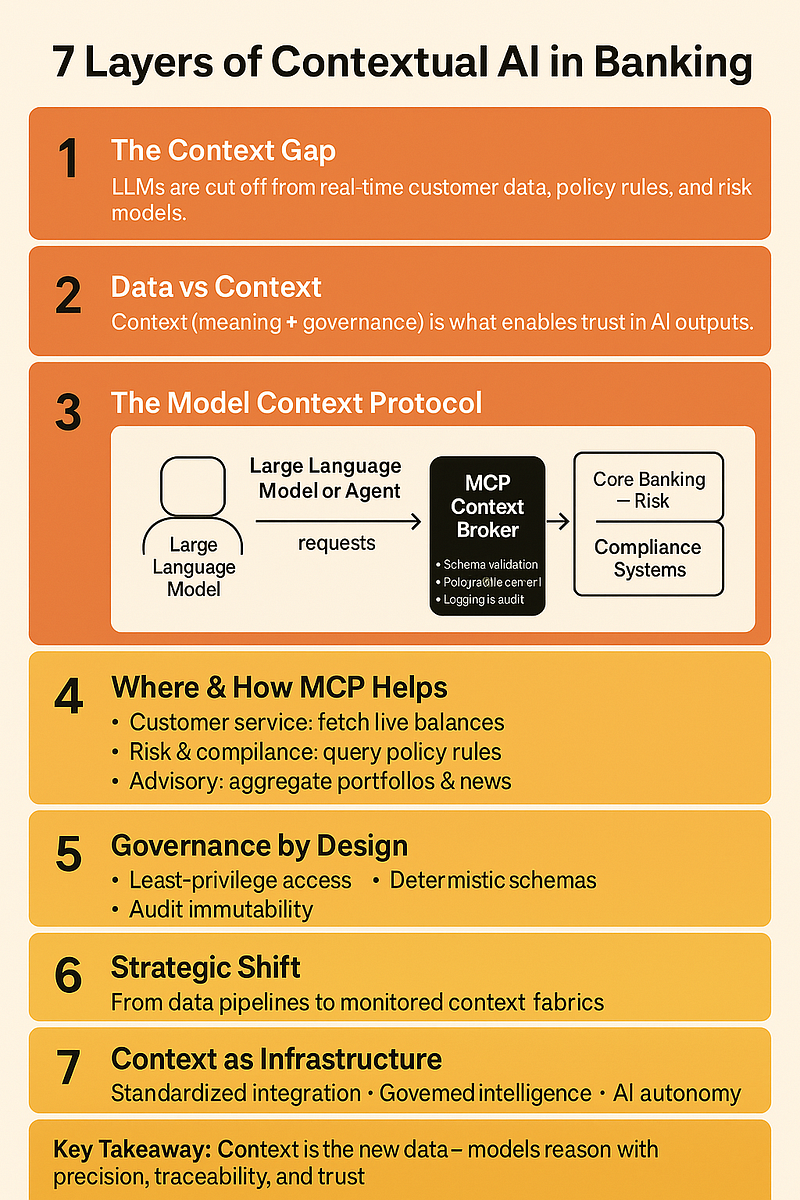
2 · Data vs. Context — and Why It Matters
For three decades, modernization has revolved around data: clean it, label it, store it. But in regulated institutions, raw data is inert.
What gives data meaning, purpose, and permission is context.
Context is metadata that behaves like a contract — it defines:
- What the information is,
- Who can use it,
- How it may be used, and
- When it is valid.
Without context, AI becomes a liability — fluent but untrustworthy.
With context, it becomes an asset — explainable, compliant, and composable.
The Model Context Protocol (MCP) elevates context to a first-class object.
Where APIs share data, MCP shares understanding.
3. How MCP Bridges the Context Gap
The Model Context Protocol — now gaining traction across OpenAI, Anthropic, and Google ecosystems — acts as a context broker between models and enterprise systems.
Instead of wiring each model into hundreds of APIs, MCP defines a standard conversation pattern:
- “What capabilities exist?”
- “What schema governs them?”
- “Am I authorized to use them?”
Key Mechanics

The LLM or agent no longer “scrapes” or “searches.”
It requests context through standardized nodes.
Every call is typed, policy-checked, and logged — transforming model access from ad-hoc API glue into auditable digital dialogue.
4. Why Banks Need This Now
Banking is the perfect storm of AI opportunity and regulation.
Three realities collide daily:
- Siloed systems — Core banking, risk, CRM, and treasury all run on different schemas and standards.
- Heavy compliance — Access to production data requires layers of approvals and masking.
- Prompt-limited AI — Most enterprise pilots rely on static text dumps or outdated knowledge bases.
MCP solves all three in one design principle: context sharing without data duplication.
When a model requests customer data, it doesn’t pull raw records — it invokes a node that already enforces KYC and consent.
When it needs policy guidance, it queries the compliance node returning both the rule and its legal source.
When it needs live FX data, it calls a read-only node tied to Reuters or Bloomberg — complete with timestamp.
All of this happens inside the bank’s perimeter — only the context crosses the wall.
5. Real Impact: Three Banking Scenarios Reimagined
1. Customer Service Copilot
Before: Chatbots that handle FAQs but can’t access real accounts.
After MCP: Conversational copilots securely fetch balances or spending patterns via nodes like getAccountSummary()or getSpendingTrend().
Impact: Real-time personalization with full audit logs and zero PII leakage.
2. Risk & Compliance Assistant
Before: Analysts manually search through policy PDFs and spreadsheets.
After MCP: AI copilots query contextual nodes — getPolicyClause(), validateThreshold() — embedding both rule text and rationale.
Impact: Seconds instead of hours to verify regulatory logic; every step traceable.
3. Wealth Advisory Copilot
Before: Advisors toggle between CRM, portfolio, and market terminals.
After MCP: One contextual interface merges holdings, risk scores, and sentiment across nodes.
Impact: Unified 360-view advice — fully explainable to clients and auditors.
Early results:
- 60 % reduction in integration effort
- 70 % fewer audit exceptions
- Consistent reasoning across model versions and teams
6. Governance as a Feature — Not an Afterthought
MCP’s core innovation isn’t just connectivity — it’s governance by design.
Every node carries metadata describing:
- Who invoked it
- When and under what policy
- Which model consumed it
This enables automatic, machine-readable compliance reports — no manual log stitching.
Built-in controls include:
- Least privilege access — models see only what their token permits.
- Deterministic schemas — strictly typed I/O eliminates prompt ambiguity.
- Immutable audit trails — every exchange carries a digital signature for forensic replay.
Instead of retrofitting controls, MCP embeds compliance into the protocol — much as HTTPS embedded security into HTTP.
Regulators are already watching closely: it provides a traceable chain of reasoning.
When a supervisor asks, “How did this model approve the loan?” — you can replay every context call, from credit check to policy validation, with full timestamps.
7. The Strategic Shift: From Data Pipelines to Context Fabrics
MCP doesn’t replace APIs or data warehouses — it orchestrates them.
It enables banks to evolve through three maturity layers:
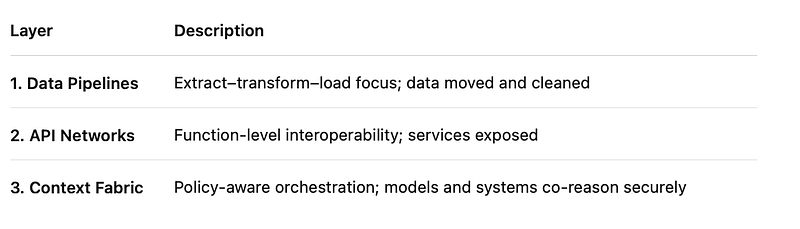
This mirrors the Web’s own evolution: static pages → dynamic APIs → contextual applications.
Banks are now entering the contextual AI phase.
By adopting MCP, they gain:
- A single integration standard for all model interactions
- Faster deployment of new AI services
- Measurable, monitorable compliance
- A future-ready foundation for AI agents and ModelOps
In short, context becomes infrastructure — the connective tissue between human insight, model reasoning, and regulatory assurance.
8 · Real-World Momentum — ContextForge MCP Gateway
Emerging gateways such as ContextForge MCP Gateway are already operationalizing these ideas.
They provide ready-made registries, adapters, and audit pipelines that let enterprises expose internal APIs as compliant MCP nodes.
For banks, this means MCP adoption can start small — a sandbox FX-rate node today, a fully governed context fabric tomorrow.
ContextForge and similar projects mark the transition of MCP from concept to deployable infrastructure.
🔚 Conclusion: Context as the Competitive Moat
In a data-rich yet regulation-heavy industry, context is the new differentiator.
Every bank can license the same LLM; few can deliver it governed, explainable, and real-time.
That is what MCP enables — a shared protocol where:
- Models speak to systems without breaching policy walls
- Compliance becomes programmable
- Innovation scales safely
Data tells you what happened. Context tells you what you can safely do next.
🔜 Next in the Series
👉 “Building Your First MCP Node — From Prompts to Protocols.”
We’ll construct a working example: how to connect a core-banking API, define its schema, and expose it securely to an AI copilot through an MCP node.