
How Anthropic’s efficiency breakthrough turns AI agents and MCP into a scalable operating fabric for banks — Article 5
🤖Agents, ModelOps, and Code Execution with MCP
How Anthropic’s efficiency breakthrough turns AI agents and MCP into a scalable operating fabric for banks — Article 5
1 · From Context Fabric to Cognitive Fabric
In the previous article, we saw how hundreds of MCP Nodes form a context fabric — a secure layer where AI systems reason within policy.
But context alone doesn’t deliver outcomes.
To truly act, banks need agents — reasoning entities that can plan, decide, and execute across those nodes — all governed by ModelOps.
Together, these three layers define the new AI enterprise stack:
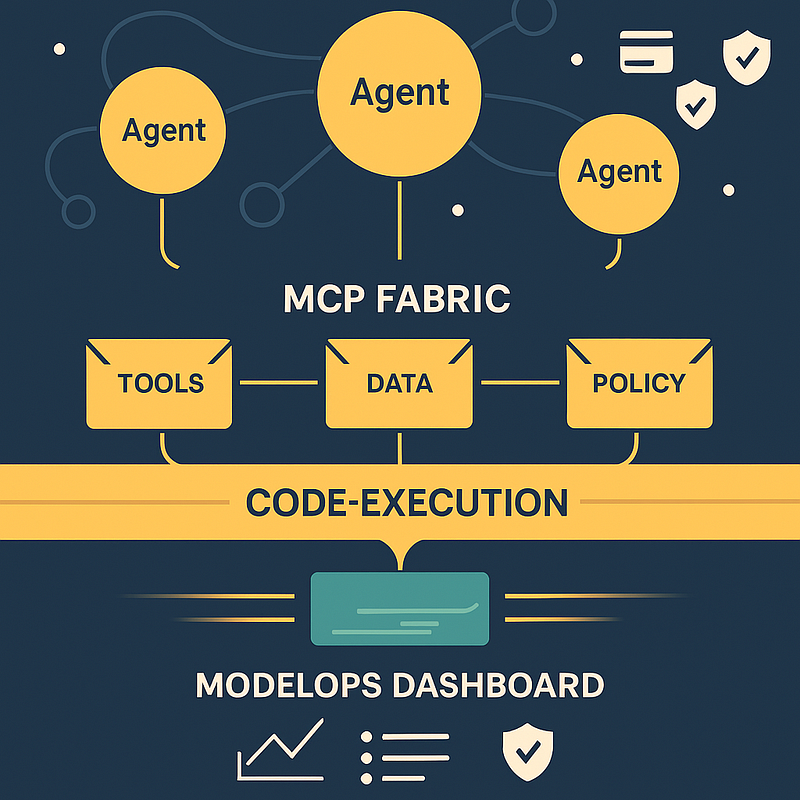
But as banks scale their use of AI — across credit, compliance, and customer operations — the question shifts from access to coordination:
How can hundreds of models, tools, and data policies operate together without losing control?
The answer lies in three interacting layers:

2 · The Agent Problem: 150 K Tokens of Bloat
Until recently, enterprise AI agents struggled with a hidden inefficiency: each tool call, memory recall, and reasoning step inflated the model’s context window — sometimes beyond 150 000 tokens per session.
That “agent bloat” made deployments expensive, slow, and brittle. In banking, where every inference must be logged and auditable, ballooning token traces meant spiraling costs and latency.
3 · Anthropic’s Breakthrough — Code Execution with MCP
In late 2025, Anthropic released a new guide showing how MCP-style architectures cut token use by 98 % — from 150 K to just 2 K tokens per workflow.
The shift hinges on one principle: move execution out of the model, not context into it.
How it works
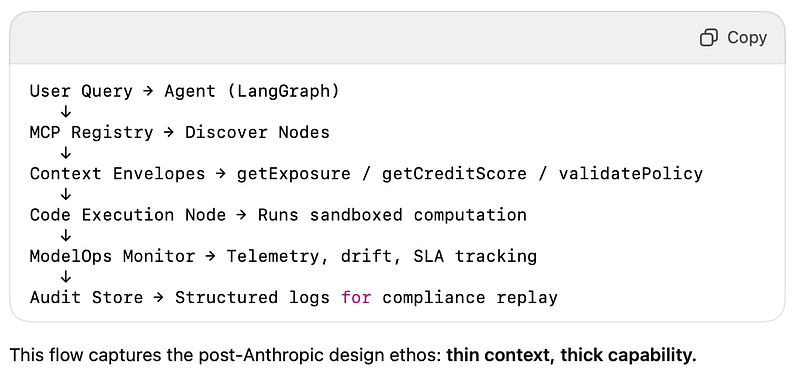
- Each reasoning step invokes tools through MCP interfaces, not inline prompts.
- Context metadata (schemas, permissions, results) travels as lightweight envelopes, not entire transcripts.
- When code must run, it executes in a sandboxed runtime via MCP’s code-exec node, returning structured output back to the model.
Result:
LLMs become context routers instead of context hoarders.
This turns multi-tool agents from memory-heavy prototypes into production-ready components.— the operational backbone ensuring every AI element behaves predictably over time.
4 · Why It Matters for Banking AI
For financial institutions, this optimization isn’t cosmetic — it’s economic.
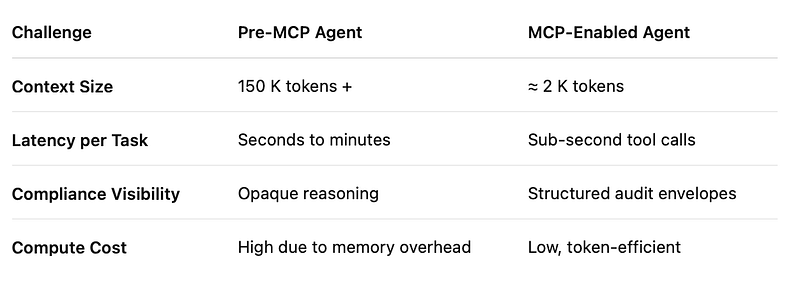
MCP effectively does for AI agents what FIX and SWIFT did for banking systems: define a protocol layer where every message is typed, auditable, and interoperable.
5 · How Agents Use MCP in Practice
An AI agent orchestrating a loan-approval workflow might perform:
- getCustomerExposure() → fetch obligations
- getCreditScore() → retrieve model output from the sanctioned registry
- validateRiskPolicy() → run compliance rules via MCP’s code-exec node
- Summarize decision context for audit via generateAuditTrail()
Because each call passes through MCP, the agent carries only context pointers, not raw data.
If one node changes its schema, the protocol adapts — no retraining or re-prompting required.
6 · Integrating ModelOps — Governance at Runtime
ModelOps is the supervisory layer ensuring every agent and model behaves within approved corridors.
In MCP environments, ModelOps manages:
- Model Registry: tracks which models can call which nodes.
- Policy Binding: links each invocation to a compliance rule.
- Telemetry Streaming: collects MCP logs for latency, access, and drift.
- Retraining & Rollback: triggers when drift or violation thresholds are met.
Together, this forms a closed feedback loop:
context → reasoning → execution → audit → optimization.
7 · Architecture Blueprint — The Efficient Agent Loop
8 · Real-World Enablers — LangGraph + ContextForge Gateway
Frameworks like LangGraph and ContextForge MCP Gateway bring this architecture to life:
- LangGraph: Builds multi-step reasoning graphs; agents plan, call tools, and branch logic dynamically.
- ContextForge Gateway: Provides registry, authentication, and telemetry modules compliant with MCP’s schema — including code-execution nodes and efficiency tracing.
Together, they allow banks to stand up token-efficient, policy-aware agent networks in days instead of quarters.
9 · Operational Governance and Telemetry
Every MCP call emits structured telemetry.
ModelOps teams can track:
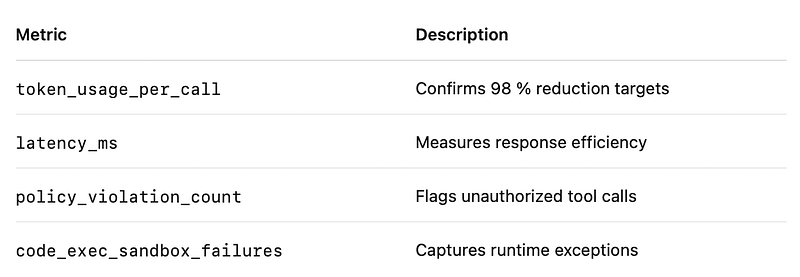
These feed into dashboards (ELK, Grafana, Prometheus) that merge performance and compliance views — the Control Tower of autonomous banking AI.
10 · Organizational Impact

MCP + Agents + ModelOps moves banks from LLM pilots to production AI ecosystems — agile, governed, and cost-efficient.
🔚 Strategic Takeaway — The End of Agent Bloat
Anthropic’s efficiency architecture proves that MCP is the missing orchestration layer for scalable AI.
By separating reasoning from execution and embedding audit into every call, banks gain:
- 98 % lower token load
- Full traceability and explainability
- Real-time operational governance
This is the AI Operating Fabric for Finance — where agents reason with context, act through code, and stay within policy.
🔜 Next in the Series
👉 “The Future of MCP in Financial Ecosystems.”
We’ll look at federated MCP networks, inter-bank context sharing, and how open standards will make contextual intelligence the foundation of digital finance.