
From conceptual nodes to real-world enterprise architecture — Article 4
🏦 Applying MCP in Banking: Risk, Compliance, and Customer Journeys
From conceptual nodes to real-world enterprise architecture — Article 4
1 · From Nodes to Networks
In the previous article, we
built our first MCP
Node — a structured, auditable capability that let a model fetch
account data safely.
But real banking AI doesn’t stop at one node.
Banks operate across hundreds of systems and policies. A true AI assistant or decision agent must bridge them all — securely and contextually.
This is where MCP’s network effect emerges: each node contributes a single capability, and together they form a Context Fabric — a living ecosystem of governed intelligence.

2 · Why Contextual AI Transforms BFSI
Three truths every banker knows:
- AI adoption is constrained by governance.
- The more regulated the function, the harder it is to embed AI safely.
- Silos kill insight.
- Credit, compliance, and customer experience each speak different data dialects.
- Explainability determines trust.
- If you can’t show how an AI reached a decision, it fails risk review.
MCP addresses all three simultaneously.
By standardizing context sharing — schema, access control, traceability — it allows AI models to operate withingovernance boundaries instead of outside them.
3 · Use Case 1 — Risk Modelling and Credit Scoring
⚙️ The Problem
Credit
teams juggle loan-origination systems, rating engines, and policy
spreadsheets.
An AI model could automate much of this, but only if it accesses
real-time exposures and sanctioned models under strict control.
🧠 How MCP Helps
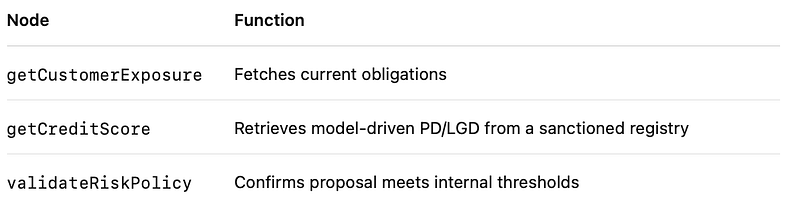
Flow
- Agent invokes getCustomerExposure() → current liabilities.
- Invokes getCreditScore() → sanctioned risk score.
- Calls validateRiskPolicy() → policy check.
Each step returns
structured, timestamped responses; every interaction is auditable.
Outcome:
A governed Credit Copilot that produces explainable
recommendations meeting model-risk and audit standards — no direct database access,
no data exports.
4 · Use Case 2 — Compliance Copilot
⚙️ The Problem
Compliance
officers spend hours digging through circulars and regulations.Generative AI can
summarize but can’t verify authenticity
without the official corpus.
🧠 How MCP Helps
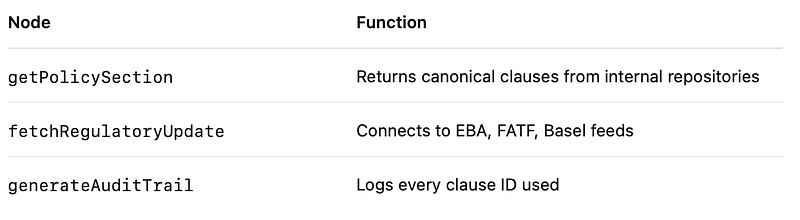
Flow
Officer: “Does this
product breach MiFID II suitability?”
- Model invokes getPolicySection(“MiFID II”).
- Cross-references fetchRegulatoryUpdate() for latest amendment.
- Generates a contextual explanation citing clause IDs via generateAuditTrail().
Outcome:
Each answer links
back to its source; explainable AI summarization with automatic
traceability.
MCP converts compliance review from document hunting to context-driven reasoning.
5 · Use Case 3 — Intelligent Customer 360
⚙️ The Problem
Customer
data lives in silos — CRM, payments, marketing, support — creating fragmented
service.
A conversational copilot needs contextual visibility without privacy
breaches.
🧠 How MCP Helps
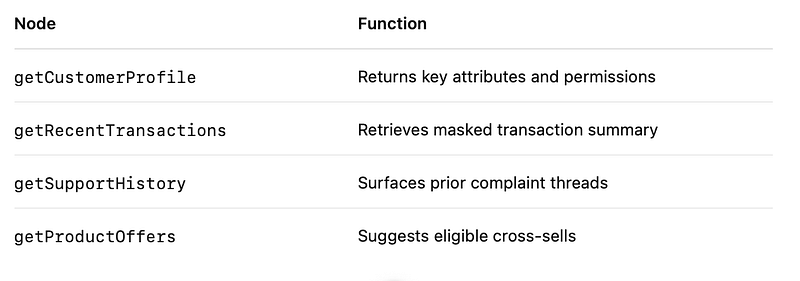
Flow
Customer: “Why was my
card declined?”
- Fetch getRecentTransactions() → declined entry.
- Pull getSupportHistory() → prior issues.
- Query getCustomerProfile() → card status / limit.
- Respond referencing policy, masking PII.
Outcome:
The copilot
speaks with understanding, not
memory — bridging systems securely for a unified, compliant, human-like experience.
6 · The Architecture — MCP-Enabled AI Fabric for Banks
These use cases share a common blueprint — the AI Operating Fabric of the future:
- Context flows, not raw data
- Access is negotiated, not hard-coded
- Every node interaction is logged
Conceptual Layers
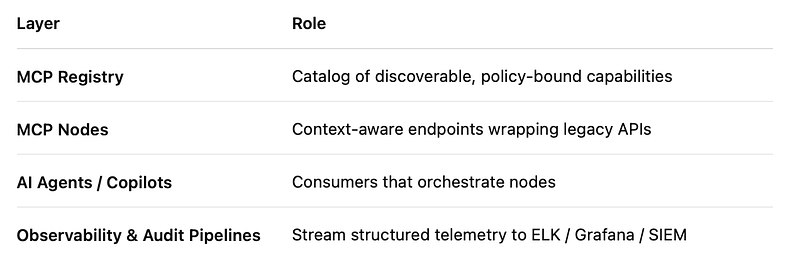
Emerging frameworks like ContextForge MCP Gateway now offer pre-built registries, adapters, and telemetry connectors — enabling banks to deploy this architecture without reinventing plumbing.
7 · How MCP Changes the Operating Model
a. For Developers
MCP
Nodes simplify integration: build once, register capability, reuse across copilots
and analytics.
b. For Risk & Compliance
Officers
MCP turns “shadow AI” into transparent AI — every
invocation is logged, reviewable, and auditable.
c. For Business
Teams
Faster delivery, lower compliance overhead, and confidence
that data never leaves policy walls.
In short: MCP moves AI governance upstream — embedding control into design, not oversight.
8 · Observability — AI That Audits Itself
Every MCP call emits telemetry — timestamped, structured, queryable.
Typical dashboard metrics
- Top 10 invoked nodes
- Access patterns by model type
- Latency per system
- Policy violations (auto-blocked)
Feeding these into ELK or Grafana yields real-time insight — the shift from black-box AI to self-governing AI ecosystems.
9 · Implementation Roadmap for Banks
- Start Small — Prototype Nodes
- Wrap one or two capabilities (FX rates, account summary).
- Establish Registry and Policies
- Use ContextForge Gateway or internal services for schema validation + policy storage.
- Expand Across Functions
- Risk → Compliance → CX.
- Integrate with Agents and ModelOps
- Connect to LangGraph / LangChain pipelines.
- Monitor and Iterate
- Build observability dashboards; track governance metrics.
🔚 Strategic Takeaway
In finance, trust is the ultimate currency — and MCP operationalizes it for AI.
By embedding context, access control, and auditability into every interaction, banks can build copilots that are:
- Compliant by design
- Context-aware by construction
- Observable by default
This is how next-generation
banking systems will work:
models that reason with context, act with policy,
and explain their every move.
🔜 Next in the Series
👉 “Agents, ModelOps, and Code Execution with MCP”
We’ll explore how MCP Nodes integrate with LangGraph agents, ModelOps pipelines, and observability systems to form the technical core of autonomous banking intelligence.